I had this thought in my mind for a long time, and it kept coming back: the best way to learn programming is when you actually need the thing you’re learning.
Let me explain what I mean.
A lot of people say, “I know loops, I know functions, I know fundamentals,” but when they try to build a real project, they get lost. The problem is simple: they know concepts, but they never used them to solve a problem they actually faced. It’s like knowing hammer, nail, and wood — but not knowing how to build anything with them.
For me, learning becomes boring when I learn something without purpose. If I study a feature just because a tutorial told me to, I don’t feel it. I don’t enjoy it. It doesn’t stay in my head.
But when I build something and hit a real problem, that’s when I learn properly.
If I write long messy code and struggle to manage it, and then I hear about functions or modules — at that moment, it makes sense. I don’t learn it as a “concept,” I learn it as a solution. That’s real learning.
The Tutorial Hell Trap
Many beginners fall into “tutorial hell.” They learn and learn, watch videos, follow steps… but they still can’t build anything on their own.
Why? Because none of that learning came from real need. It was just information with no meaning.
But when you struggle with your own project and then discover the solution — you remember it forever. Your brain connects it with the feeling of relief. That emotional connection makes the knowledge stick.
It Doesn’t Mean You Should Wait
This principle doesn’t mean you should sit and wait for problems to magically appear. That’s wrong.
You need to prepare your environment so these learning moments naturally come to you.
How? By building small projects with the basics you already know.
If I never built a real project with JavaScript or React, I would never face type mismatches. I would never feel the pain that pushed me toward TypeScript. And without that pain, TypeScript just looked like extra work.
My TypeScript Story
The first time I tried TypeScript, I understood the idea of “type‑safe,” but I didn’t feel why it mattered. Writing TS and compiling back to JS felt like extra steps with no benefit. So I stopped — even though everyone said it was great.
Months later, when I was building a React app, I started facing real type mismatches. My code was breaking in ways that were hard to catch. I wished there was something to help me.
Then I remembered TypeScript.
I looked into it again, and suddenly everything clicked:
“Ahh, this is exactly what I need for my project.”
So I learned TypeScript — not to “study,” but to solve a real problem and upgrade my project. And this time, it wasn’t boring at all. It was exciting.
My Simple Principle
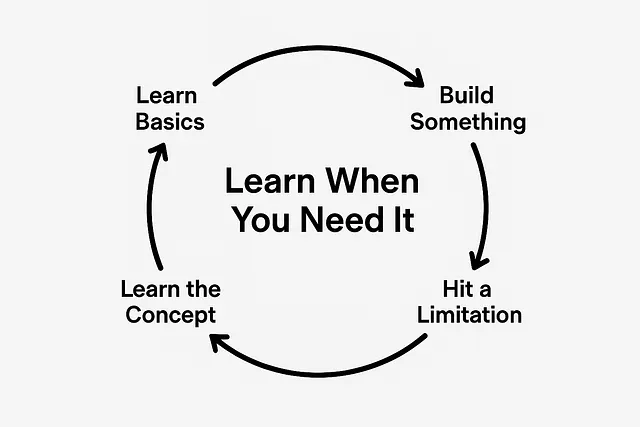
- Learn the basics.
- Build something (small is enough).
- When you hit a limitation or pain → learn the concept that fixes it.
- Apply it immediately.
- Repeat.
Even if your project is super simple, it doesn’t matter. You will still reach moments where you feel, “I need something more here.” That moment is the best time to learn.
This is how I grow as a programmer, and honestly, this keeps learning fun, meaningful, and real.
Conclusion
At the end of the day, programming is not about collecting concepts. It’s about solving problems. When you learn something because your project truly needs it, the knowledge becomes part of you. It sticks, it makes sense, and it gives you confidence for the next challenge.
So keep this simple cycle: learn the basics → build anything → hit a limit → learn the next thing → improve.
Do this consistently, and you’ll grow faster than you ever expected.